

Updated July 2026 · Reviewed by the United HVAC Motors technical team
Labor is 40 to 60% of the bill. Here is what it buys.
- Installation labor: $1,200 to $3,500 on a typical job
- Total installed: $3,000 to $8,000, most homes at $4,500 to $6,500
Installation quality affects performance more than brand does. The same furnace, correctly commissioned or not, is effectively two different products. This guide covers what a proper installation includes and how to verify you got one.
For equipment pricing and efficiency tiers see our new furnace cost guide; for the repair-or-replace decision and bid comparison, our furnace replacement guide. This one is about the work itself.
What Drives Labor Cost
| Factor | Effect |
|---|---|
| Basement, good access | Baseline labor |
| Utility closet | Adds time; combustion air and clearance planning required |
| Attic or crawlspace | Substantially higher — materials carried by hand, restricted working position |
| 80% to condensing conversion | New PVC venting, condensate drainage, and a solution for any orphaned water heater |
| Fuel conversion | Gas piping, meter capacity, combustion air — the largest single escalation |
| Duct modification | $500 to $3,000, and the line most often excluded from a low bid |
What a Proper Installation Actually Includes
Fitting the cabinet and connecting the ducts is perhaps half the job. A complete installation also covers:
- Manual J load calculation — sizing from the house, not from the old unit's label.
- Static pressure measurement — before and after, so the ducts are known to support the equipment.
- Correct plenum and transition work — new cabinets rarely match old footprints, and a sloppy transition adds resistance permanently.
- Venting to code — correct pipe size, slope, and termination clearances.
- Condensate drainage — with a trap, and a pump where gravity is unavailable.
- Gas pressure verification — manifold pressure checked and set, not assumed.
- Blower speed configuration — heating and cooling taps set to the design airflow for this house.
- Commissioning — the measurements below.
- Permit and inspection.

Have the model number handy?
Match it in the serial number lookup and see the exact remanufactured motor, price and warranty.
The Commissioning Numbers to Ask For
This is the section worth printing. Before final payment, ask for these four readings in writing. A competent installer will already have them; one who does not will need to come back and take them, which is exactly the point.
1. Temperature Rise
Supply air temperature minus return air temperature, at steady state. Must fall inside the range printed on the furnace data plate. Above it means insufficient airflow and an overheating heat exchanger. Below it means excessive airflow and cold drafts.
2. Total External Static Pressure
Supply plus return, measured with a manometer, compared against the equipment rating — usually 0.5 in. WC. This is the reading that predicts whether the system will perform and how long the blower motor will last. See what ideal static pressure is.
3. Gas Manifold Pressure
Measured and set to the manufacturer's specification, not left at whatever it arrived at. Incorrect manifold pressure means the furnace is over- or under-firing.
4. Blower Amp Draw
Clamped and compared to the motor nameplate. Over nameplate amps on day one means the blower is already overloaded, and the motor will fail years early in equipment that is brand new.
Why this matters more than the brand. A premium furnace with unmeasured static pressure and a wrong blower tap will underperform a mid-range unit that was commissioned properly. Most "this new furnace is no better than the old one" complaints trace back to skipped commissioning, not to the equipment.

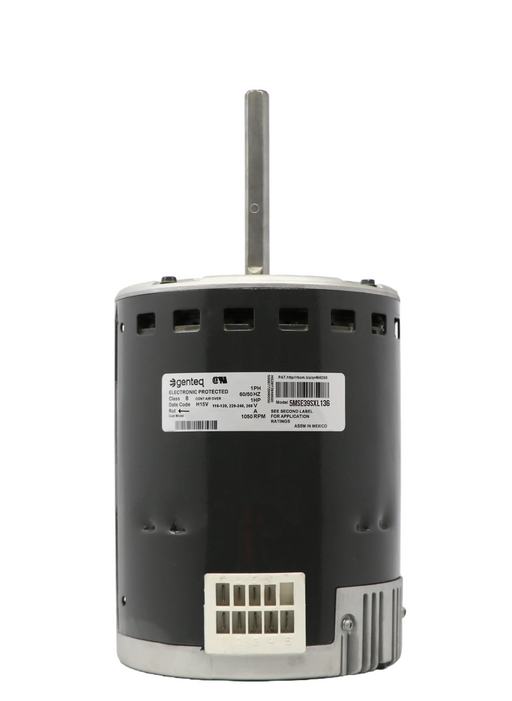
Motor de soplador Genteq 5MSE39SXL136 ECM X13 1 HP
Motor remanufacturado por United HVAC Motors Garantía de reemplazo de 2 años (se aplican términos) Plug n Play - 100% programado ...
Ver todos los detallesRed Flags in an Installation Quote
- Sizing quoted over the phone. Nobody can size a furnace without seeing the house.
- "Same size as what you have now." That assumes the previous installer was right.
- No mention of static pressure or duct evaluation.
- No permit in the price. Either it is coming later, or it is not being pulled.
- Silence on the water heater when a shared chimney is being abandoned for PVC venting.
- No labor warranty stated separately from the manufacturer's parts warranty.
- Same-day pressure to sign. Legitimate contractors are busy, not desperate.
Installation vs. Replacement
A replacement reuses existing ducts, venting and utilities where they are adequate, which keeps cost down. A first-time installation or a fuel conversion has to build that infrastructure — duct runs, gas piping, electrical service, venting — and costs substantially more as a result.
Where the two get confused is when a replacement should have included infrastructure work and did not. Reusing ducts that were never adequate is not a saving; it is a deferred cost that shows up as poor comfort and early component failure.
Timing
Spring and early fall are the cheapest and the calmest. Emergency installation in January costs more, offers no time to compare bids, and is the scenario in which corners get cut — including the commissioning steps above, which are the first thing to disappear when a crew is racing daylight in February.
FAQs
How much does furnace installation cost in 2026?
$3,000 to $8,000 installed, with most homes between $4,500 and $6,500. Labor alone is typically $1,200 to $3,500, or 40 to 60% of the total.
What should a furnace installation include?
A Manual J load calculation, static pressure measurement, correct plenum and transition work, code-compliant venting, condensate drainage, verified gas manifold pressure, blower speed configuration, commissioning measurements, and a pulled permit.
How do I know if my furnace was installed correctly?
Ask for four readings in writing: temperature rise against the data plate range, total external static pressure, gas manifold pressure, and blower amp draw against the motor nameplate. A competent installer will already have them.
Does installation quality matter more than furnace brand?
Yes. The same furnace commissioned properly or not behaves like two different products. Most complaints that a new furnace is no better than the old one trace back to skipped commissioning rather than to equipment.
Why is attic furnace installation more expensive?
Access. Materials are carried by hand, technicians work in restricted positions, and everything takes longer. The equipment is identical; the labor hours are not.
Do I need a permit to install a furnace?
In most U.S. jurisdictions, yes, and inspection is part of it. A quote that omits the permit is either adding it later or not pulling one, which can create problems at resale and may affect insurance claims.
Next Steps
Ask for the four commissioning readings before final payment. If a new installation is not in the budget and the existing furnace is sound apart from a failed blower, a programmed remanufactured motor with a 2-year warranty is a fraction of the cost. USA-based technical support in English and Spanish.