

Updated July 2026 · Reviewed by the United HVAC Motors technical team
Key takeaways
- Carrier furnace fault codes are LED flash sequences (short flashes, then long flashes) read at the control board sight glass. Code 3-1 means 3 short and 1 long.
- Airflow faults (1-3, 3-3) are the most common and are usually fixed with a filter change and open vents, not new parts.
- Code 4-1 (blower outside valid speed range) and indoor unit E3 are the two codes that most often end in a blower motor replacement.
- The same code can mean different things on different equipment: E3 on an indoor unit points to fan speed, while E3 on some outdoor units points to board communication.
- Always cut power at the breaker and disconnect before touching the board, motor, or capacitor. Capacitors hold a charge after shutdown.
When the system fails and you see a blinking LED or an error display on your Carrier furnace or AC, it is not just annoying. It is a tech-level fault code telling you what is wrong. Decoding these error alerts quickly can save you from burned-out motors, higher energy bills, and system breakdowns.
Below you will find a detailed breakdown of error codes for Carrier furnaces and for Carrier air conditioners (especially the E3 code) with real-world explanations of what is happening, what to inspect, and when you should call in a pro. If your blower motor is humming, burning up, or completely dead, you do not have to guess part numbers: our remanufactured Genteq ECM blower motors ship programmed and ready to install.
Safety first: Cut power at the breaker and the service disconnect before opening the cabinet. Blower and inducer capacitors store a charge even with the system off, and gas-side faults (ignition, flame proving, gas valve) should be left to a licensed technician.
Carrier Furnace Error Codes: Quick Reference
Carrier furnace boards signal faults with LED flash sequences of short and long flashes. Match your code here first, then read the detailed section below.
| Code | Meaning | Most common cause |
|---|---|---|
| 1-1 | No previous fault code stored | Board was reset or power interrupted |
| 1-2 | Blower runs after power-up during call for heat | Normal timed run; watch for erratic blower |
| 1-3 | Limit or flame rollout switch lockout | Restricted airflow or venting problem |
| 1-4 | Ignition lockout | Failed ignitor, dirty flame sensor, low gas pressure |
| 2-1 | Gas heating lockout (no auto-reset) | Gas valve, wiring, or control fault |
| 2-2 | Abnormal flame-proving signal | Stuck gas valve, dirty flame sensor, wiring |
| 2-3 | Pressure switch did not open | Blocked vent, bad inducer, stuck switch |
| 2-4 | Secondary voltage fuse open | Short in secondary wiring or board |
| 3-1 | Pressure or draft safeguard did not close or reopened | Inducer, vent sizing, or blower drag |
| 3-3 | Limit or rollout switch opened during operation | Overheating from failing blower or throttled return |
| 3-4 | Ignition proving failure | Flame sensor, ignitor, valve, wiring, ground |
| 4-1 | Blower outside valid speed range | Failing blower motor, wheel drag, weak capacitor |
| 4-2 | Inducer outside valid speed range | Weak inducer motor, bearings, impeller, wiring |
| 4-3 | Pressure switch calibration faulty | Condensate backup, vent pipe issue |
👉🏻 Read More: Troubleshooting an HVAC Fan Not Working: Common Causes and Solutions
Carrier Furnace Error Codes in Detail
Code 1-1 (1 short, 1 long): No previous code
This code indicates that there is no previous fault recorded in memory. Essentially the control board has been reset, either from a power interruption or a manual control reset. You are starting fresh. If you are seeing this, it is not the fault itself. It is telling you there is no fault history, which puts you at the beginning of diagnostics.
Code 1-2 (1 short, 2 long): Blower runs after power-up during call for heat
In this scenario the blower runs for about 90 seconds after power is applied because the control detected that the unit was already calling for heat (R-W closed) at startup. Mechanically it means the blower motor is being commanded and the board is timing the post-power-up run. If everything else is normal after that, you are fine. If the blower fails to run or runs erratically, check blower startup, the capacitor, and wheel condition, and see our guide on how to test a blower motor.
Code 1-3 (1 short, 3 long): Limit or flame rollout switch lockout
This fault means a high-limit or rollout switch (a safety device) has opened and locked the furnace out. It is commonly caused by restricted airflow (dirty filter, closed return or supply vents), a blocked secondary heat exchanger, or flame rollout from a venting problem. In practice we have seen blower motors working fine while low airflow trips the limit switch fast. Fix the airflow or venting first before swapping parts.
Code 1-4 (1 short, 4 long): Ignition lockout
The furnace attempted ignition a set number of times, failed, and locked out. Typical culprits are a failed hot surface ignitor, a cracked or dirty flame sensor, low gas pressure, poor flame carryover, or gas valve issues.
Code 2-1 (2 short, 1 long): Gas heating lockout
In this case the control board will not auto-reset. The furnace detected a sustained fault in the gas-heating circuit: a bad gas valve, a wiring issue, or a defective control. It is more than a simple limit switch opening. If you see this, it is time for deeper diagnostics on the burner assembly, gas train, and control board.
Code 2-2 (2 short, 2 long): Abnormal flame-proving signal
The flame sensor proved flame when it should not have (gas valve de-energized), or the signal is erratic. Possible causes include a stuck-open gas valve, a burned-out flame sensor, a wiring short, or a control board fault. On service calls we sometimes remove the flame sensor, clean it, and the fault clears, provided wiring and gas pressure check out.
Code 2-3 (2 short, 3 long): Pressure switch did not open
The inducer motor started, but the pressure switch did not open as expected. This can mean a blocked vent pipe, a bad inducer motor, a defective pressure switch, or kinked or blocked tubing. We have pulled ductwork only to find bird nests or blocked PVC venting causing this exact code.
Code 2-4 (2 short, 4 long): Secondary voltage fuse is open
This is an electrical fault in the control circuit. The secondary-side fuse on the board (often 3 A) is blown, which means there is a short somewhere in the secondary wiring or the board itself. Check wiring, the board, and insulation, and make sure nothing is contacting the chassis.
Code 3-1 (3 short, 1 long): Pressure, draft safeguard, or aux-limit switch did not close (or reopened, downflow only)
The furnace is detecting that after startup the draft or pressure circuit did not close in time or reopened during operation. This can relate to inducer motor voltage, inadequate vent sizing, a blower motor issue such as a dragging wheel, or a restricted vent. In attic installs we have felt the inducer running hot from overwork under this fault.
Code 3-3 (3 short, 3 long): Limit or flame rollout switch is open (after 3 minutes)
Similar to 1-3, but triggered after a few minutes of operation. The high limit or rollout device opened while running. We have seen this when blower motors are failing, ducts are collapsing, or return airflow is throttled, all of which lead to overheating.
Code 3-4 (3 short, 4 long): Ignition proving failure
The furnace attempted ignition and flame was not sensed within the proving period, then it retried and locked out. Check the flame sensor, ignitor, valves, wiring, and ground.
Code 4-1 (4 short, 1 long): Blower outside valid speed range
The blower motor speed feedback (ECM or PSC) is outside what the control expects. Causes include blower wheel drag, a dirty wheel, worn bearings, a slipping motor, a weak capacitor, or the motor itself failing. We have replaced blower motors mid-winter because this code kept returning at every startup. This is the furnace code most likely to end in a motor replacement, and a programmed remanufactured Genteq ECM unit is usually the fastest fix.
Code 4-2 (4 short, 2 long): Inducer outside valid speed range
The inducer motor or its control is not running at the expected speed. Causes include a weak inducer motor, failing bearings, impeller damage, or a wiring or voltage issue. We once found a squirrel had shoved nesting material into the inducer housing, slowing it enough to trigger this code.
Code 4-3 (4 short, 3 long): Pressure switch calibration faulty
The pressure switch, hose, or venting circuit is out of spec. Common causes include condensate trap water backing up, vent pipe collapse, or a tilted vent motor shaft. In these cases the fix was clearing the trap and verifying vent pipe integrity.
To confirm product availability please call (813)440-8108. Some items might be in stock but not yet prepared to be shipped.
Remanufactured Motor by United HVAC Motors
2 Year Replacement Warranty (Terms Apply)
Plug n Play - 100% Programmed
Match your Motor Model N...

 Sold out
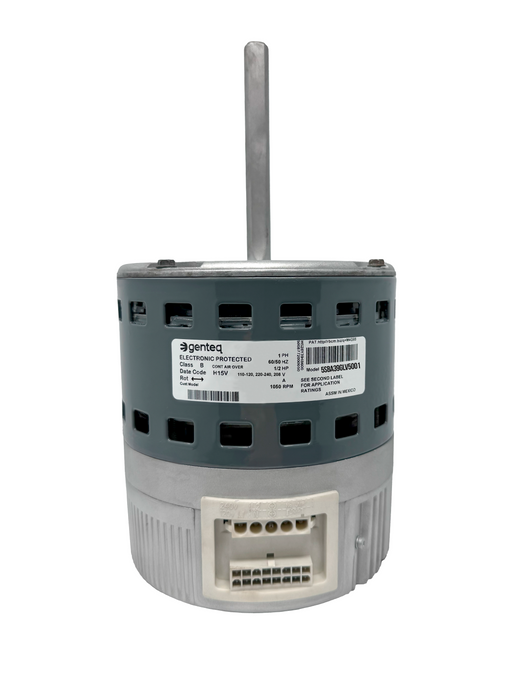
5SBA39GLV5001 GE Genteq Blower Motor ECM EON 1/2 HP
Sold out
5SBA39GLV5001 GE Genteq Blower Motor ECM EON 1/2 HP
5SBA39GLV5001 GE Genteq Blower Motor ECM EON 1/2 HP

Are you an HVAC company?
Save big with our B2B program: trade pricing on 30,000+ remanufactured Genteq motors, same-day processing and a 2-year warranty.
Carrier AC and Heat Pump Error Codes
When your Carrier split-system air conditioner or heat pump shows something like E3 on the indoor or outdoor unit display or remote, it is usually not a simple thermostat blip. It often points to fan speed, sensor, or communication faults. These codes require a careful tech check, because ignoring them can lead to motor failure, compressor damage, or inefficient cooling.
Code E3 on the indoor unit: indoor fan speed out of control
E3 on the indoor unit means the motor or fan controller detected the indoor blower running too slow or too fast, outside expected parameters. The blower must pull air over the evaporator coil at the correct CFM; when that falls out of spec, you lose performance or risk coil icing and high static pressure. In the field we find this when blower motor bearings are shot, the wheel is caked in lint, the capacitor has weakened, or the feedback tachometer lead is broken. If the motor is the culprit, our guide on troubleshooting your HVAC blower motor covers the tests, and testing with a multimeter confirms it.
Code E3 on the outdoor unit: communication malfunction between IPM board and outdoor main board
On some Carrier outdoor units the same E3 code means a communication failure between the IPM (intelligent power module) board and the outdoor main board, so the inverter compressor is not receiving valid signals. It could be a wiring fault, a poor connector, a board failure, or IPM overheating. Although it is labelled with the same code, the location and the suspected component differ completely from the indoor E3.
What to Do When You Encounter These Codes
When a code is flashing and the system is acting up, follow the practical steps we use on service calls. First, make it safe: turn off power. Do not assume the system is broken in a benign way. Overheating motors, locked rotors, blocked vents, and gas faults can escalate.
If you are comfortable doing some inspection yourself: check and replace the air filter, make sure all supply and return vents are open, look for debris or blockage in intake and exhaust vents, check for a blown breaker or tripped disconnect, inspect the blower wheel and motor for dust, looseness, or wobble, listen for bearing noise, compare blower motor amps against spec, inspect the control board for burn marks, and check wiring harnesses for loose connections. If the code repeats after these checks, you are looking at component failure (motor, board, pressure switch, inducer) and a trained technician should take over. If it turns out to be the motor and you are weighing repair against replacement, our blower motor replacement cost guide breaks down the numbers.
For any blower-motor-specific fault (Code 4-1 on a furnace or an indoor unit E3 on AC), United HVAC Motors stocks matched replacement motors with direct support to pin down the correct part number, so you avoid installing the wrong motor, wrong speed, or wrong voltage. Contractors sourcing locally can also compare options in our city guides, such as the top blower motor distributors in Houston or in Chicago.
Frequently Asked Questions
How do I read a Carrier furnace error code?
Watch the LED through the sight glass on the control board. Count the short flashes, then the long flashes. Two short and three long is code 2-3. The legend is also printed on the door panel or the wiring diagram of most Carrier furnaces.
Which Carrier codes point to the blower motor?
Code 4-1 (blower outside valid speed range) is the most direct blower motor fault on furnaces, and E3 on the indoor unit is its equivalent on split-system AC. Codes 1-3, 3-1, and 3-3 can also involve the blower indirectly when a dragging wheel or weak motor restricts airflow and trips a limit.
Can I clear a Carrier error code by cutting power?
Cycling power clears the display and resets the board, but it does not fix the underlying fault. Lockout codes such as 2-1 will either return immediately or reappear at the next failure. Use the code to diagnose the cause before resetting.
Is it safe to keep running the system with an error code?
No. Safety lockouts exist to prevent overheating, flame rollout, and electrical damage. Running a system that keeps tripping codes risks turning a cheap fix into a burned motor, a cracked heat exchanger, or a dead board.
Do I need a Carrier-branded replacement motor?
No. What matters is an exact match on specifications and programming. A remanufactured Genteq ECM unit programmed for your model installs plug-and-play and carries a 2-year warranty. Send us your model number and we will match the correct motor.
Summary
When your Carrier system is throwing one of these codes, you now know which component is likely at fault, what to check, and roughly how urgent it is. You are no longer flying blind. If you need help identifying the exact motor, control board, or component matched to the fault code, browse our remanufactured Genteq ECM blower motors or visit unitedhvacmotors.com and tell us your model number. We will help you get the right motor shipped fast so your system can breathe again.