

Updated July 2026 · Reviewed by the United HVAC Motors technical team
Before you open the cabinet.
- Power off at the breaker, not the thermostat.
- Discharge the run capacitor before your hands go near the wiring. It holds a lethal charge with the system off.
- Never spray liquid on an ECM control module or on any motor windings. Water and electronics end the job permanently.
The part that actually matters
Cleaning the outside of the motor accomplishes very little. The blower wheel is the job.
Dust bonds to the concave face of each fin. Once a layer builds up, the fins stop behaving like scoops and the wheel moves a fraction of the air it was designed to move. A badly caked wheel can cost you a third of your airflow while looking, from the access panel, more or less fine. That lost airflow is what raises static pressure, and static pressure is what kills blower motors.
Two Levels of Clean
Be honest about which one you are doing, because they are not equivalent.
- In-place tidy (30 minutes). Vacuum the compartment, brush the accessible fins, wipe the motor housing. Worth doing annually. It removes maybe a quarter of the buildup on a dirty wheel.
- Wheel-out clean (2 to 3 hours). Pull the blower assembly, remove the wheel from the shaft, clean every fin from both sides. This is the one that restores airflow.
If your airflow has visibly dropped, the in-place version will not fix it. If you are already replacing the motor, clean the wheel while it is off — you will never have a better opportunity. See how to replace an HVAC blower motor.
Tools
- Nut driver and screwdriver set; hex keys for the wheel set screw
- Shop vacuum with a brush attachment
- Soft nylon brush and an old toothbrush for the fins
- Insulated gloves, safety glasses, dust mask
- Coil cleaner or mild degreaser, and rags
- Phone, for photographing the wiring before anything moves
Are you an HVAC company?
Save big with our B2B program: trade pricing on 30,000+ remanufactured Genteq motors, same-day processing and a 2-year warranty.
Step 1: Find It and Get Power Off
Breaker off, confirm dead, discharge the capacitor. If you are not sure where the blower sits in your system, see where your HVAC blower motor is located.
Step 2: Vacuum Before You Blow
This order matters and most guides get it backwards. Vacuum the loose dust out of the compartment first. If you start with compressed air, you drive dust straight into the motor vents and into the evaporator coil sitting directly above it — turning one cleaning job into two.
When you do use air, blow outward, away from the motor body.

Step 3: Pull the Assembly (For a Real Clean)
Photograph the wiring from several angles before disconnecting anything. Then remove the two or three bolts holding the blower assembly to the cabinet and slide the whole thing out. Working on the floor beats working folded into a furnace cabinet, and it lets you reach the back of the fins.
Step 4: Remove the Wheel
- Mark the depth on the shaft before loosening anything. The wheel must go back at exactly the same position or it will scrape the housing or lose efficiency.
- Loosen the set screw on the hub. It is often torqued hard.
- Expect resistance. Years of heat cycling seize the wheel to the shaft. Penetrating oil and patience.
- Never pry against the fins. Bent fins permanently unbalance the wheel, and an unbalanced wheel destroys motor bearings.
Step 5: Clean the Fins
Work the concave face of each fin with a brush. This is tedious and it is the entire point of the exercise — there is no shortcut that gets the caked layer off the inside curve.
For heavy grease buildup (common in kitchens), a coil cleaner or mild degreaser helps. If you wash the wheel:
- The wheel comes off the motor first. Always.
- Dry it completely before reassembly. Residual moisture invites rust and imbalance.
- Nothing wet goes anywhere near the motor or the control module.
Check the fins for damage while you are there. A wheel with bent or missing fin material should be replaced, not just cleaned.
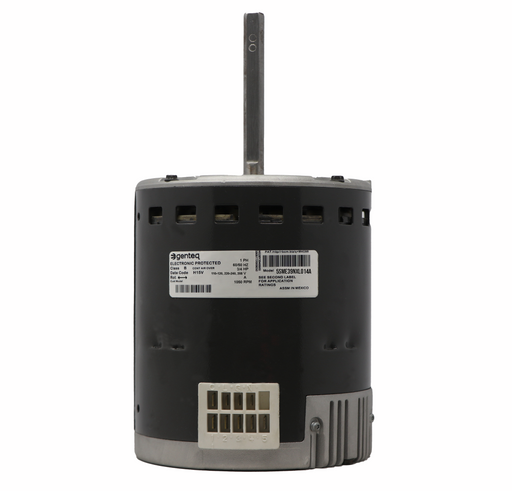
5SME39NXL014A GE Genteq Blower Motor ECM X13 3/4 HP
Remanufactured Motor by United HVAC Motors 2 Year Replacement Warranty (Terms Apply) Plug n Play - 100% Programmed Match your Motor Model N...
View full details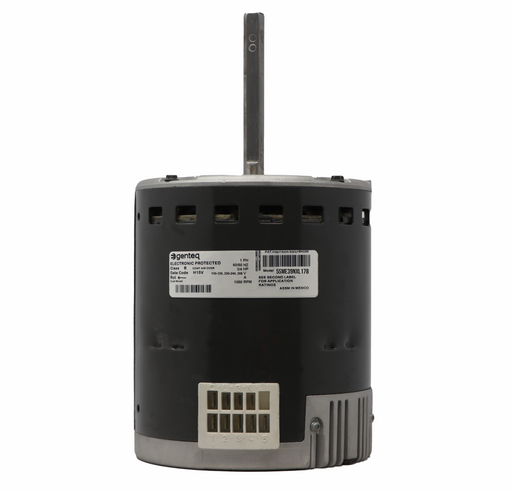
5SME39NXL178 GE Genteq Blower Motor ECM X13 3/4 HP
Remanufactured Motor by United HVAC Motors 2 Year Replacement Warranty (Terms Apply) Plug n Play - 100% Programmed Match your Motor Model N...
View full detailsStep 6: Do Not Lubricate (Almost Certainly)
Older motors had oil ports — small covered holes at each end of the housing. If yours has them, a few drops of non-detergent electric motor oil, once a year.
Most modern motors are permanently sealed and have no ports. There is nothing to lubricate. Forcing oil into a sealed motor, or spraying penetrating lubricant on the bearings, does no good and can wash out the factory grease. If you cannot see a dedicated oil port, skip this step entirely.
ECM motors are never lubricated.
Step 7: Reassemble and Verify
- Fit the wheel at the marked depth, set screw on the shaft flat, torqued properly.
- Slide the assembly back, bolt it down, rewire from your photos.
- Restore power and call for fan.
- Listen. Scraping means wrong wheel depth. Vibration means the wheel is unbalanced or the set screw is loose. Either one, shut it down and recheck — do not let it run.
- Confirm airflow improved at the vents. If it did not, the restriction is elsewhere: filter, ducts, or a closed damper.
How Often, and What Cleaning Will Not Fix
Once a year is right for most homes. More often with pets, smokers, ongoing construction dust, or if the system runs continuously.
But be clear about the limit: cleaning removes a symptom, not the cause. If the wheel cakes up again within a year, the real problem is upstream — a low-grade filter, a filter changed too rarely, or return ducts pulling unfiltered air through gaps in the cabinet. Fix that, or you will be back in here every season.
And cleaning will not save a motor with failed bearings or a dead ECM module. If it was squealing, grinding, or cutting out before you cleaned it, see how to test an HVAC blower motor.
FAQs
How do I clean an HVAC blower motor?
Power off at the breaker and discharge the run capacitor. Vacuum the compartment before using compressed air. For a real clean, pull the blower assembly, mark the wheel depth, remove the wheel from the shaft, and brush the concave face of every fin. Cleaning the motor housing alone does very little.
Do I need to remove the blower wheel to clean it?
For a cleaning that actually restores airflow, yes. Dust bonds to the inside curve of each fin, and that surface cannot be reached properly with the wheel in place.
Can I use water on a blower motor?
Not on the motor itself and never on an ECM control module. The wheel can be washed once it is off the shaft, provided it is completely dry before reassembly.
Should I oil my blower motor?
Only if it has visible oil ports, which most modern motors do not. Sealed motors have nothing to lubricate, and ECM motors are never oiled.
How often should a blower motor be cleaned?
Annually for most homes; more often with pets, smokers, or construction dust. If it cakes up within a year, the real problem is filtration or unfiltered air being pulled in through gaps in the cabinet.
Will cleaning the blower motor fix weak airflow?
Often, if the wheel was caked. If airflow does not improve, the restriction is elsewhere — a clogged filter, restricted ducts, or a closed damper.
Next Steps
If the motor was noisy or intermittent before cleaning, cleaning will not fix it. Compare an OEM quote against a programmed remanufactured motor with a 2-year warranty. USA-based technical support in English and Spanish.
To confirm product availability please call (813)440-8108. Some items might be in stock but not yet prepared to be shipped.

 Sold out
5SME39SXL224 GE Genteq Blower Motor ECM X13 1 HP
Sold out
5SME39SXL224 GE Genteq Blower Motor ECM X13 1 HP
5SME39SXL224 GE Genteq Blower Motor ECM X13 1 HP
Remanufactured Motor by United HVAC Motors 2 Year Replacement Warranty (Terms Apply) Plug n Play - 100% Programmed Match your Motor Model N...
View full details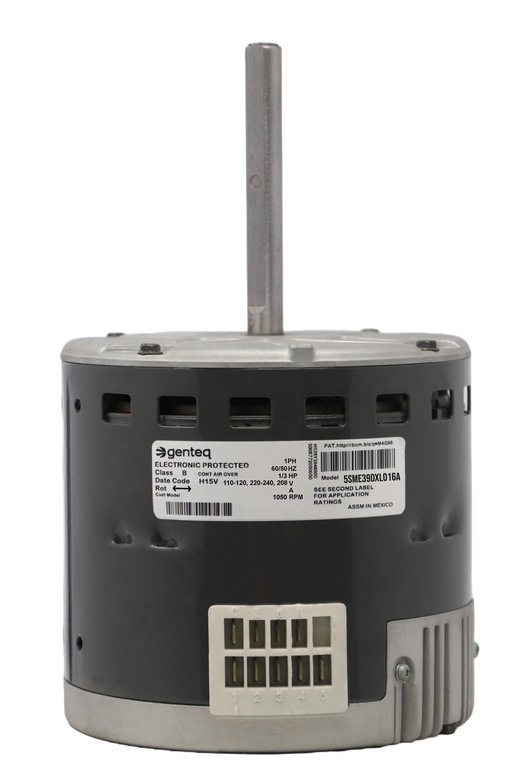
5SME39DXL016A GE Genteq Blower Motor ECM X13 1/3 HP
Remanufactured Motor by United HVAC Motors 2 Year Replacement Warranty (Terms Apply) Plug n Play - 100% Programmed Match your Motor Model N...
View full details